
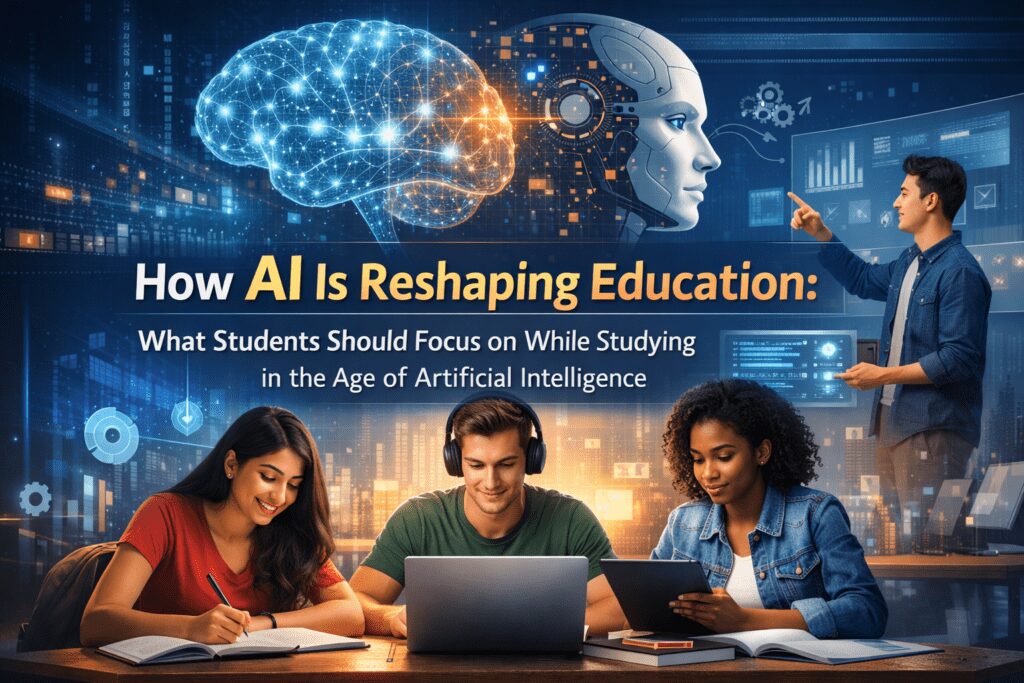
How AI Is Reshaping Education is no longer a futuristic idea — it is already transforming industries, workplaces, and classrooms around the world. From automated customer support to data-driven decision making, Artificial Intelligence is changing how organizations operate and redefining the skills employers seek.
For today’s students, this shift brings both opportunity and responsibility. Academic success alone is no longer enough. To thrive in an AI-driven world, students must rethink what they learn, how they learn, and how they prepare for their careers.
Why AI Changes the Way Students Should Learn
AI can process information faster than humans, automate repetitive tasks, and generate insights from massive datasets. However, it still relies on human creativity, judgment, and emotional intelligence.
This means future professionals won’t compete against AI — they’ll work with it.
As a result, employers increasingly value:
– Problem-solving ability
– Critical thinking
– Digital literacy
– Communication skills
– Adaptability
Students who develop this alongside academic knowledge will stand out in the job market.
1. Build Strong Fundamentals
Many students rush to learn the latest software or trending technologies. While tools matter, strong fundamentals matter more.
Regardless of discipline, students should focus on:
– Logical thinking
– Core subject knowledge
– Analytical reasoning
– Clear written and verbal communication
AI tools evolve rapidly, but foundational skills stay relevant for life, as per Lakshmi Hariharan, Founder, Principal at Srushti Degree College, based out in Bangalore. She emphasizes that while technology continues to change, students who build strong basics in problem-solving, communication, and critical thinking are better equipped to adapt to new tools and workplace demands. These core abilities help graduates transition smoothly across roles and industries, making them more resilient in an evolving job market. By strengthening fundamentals early, students’ future-proof their careers and gain confidence to learn emerging technologies faster.
Tip: Instead of memorizing answers, understand why concepts work. This builds long-term career resilience.
2. Develop Digital and AI Literacy : Understanding How AI Is Reshaping Education
Students should aim to understand how AI systems are trained, including how algorithms learn from data patterns to make predictions and decisions.
It’s equally important to know what data is and how it’s used — from collecting information responsibly to understanding how data quality impacts outcomes.
Learning basic automation concepts helps students understand how repetitive tasks can be streamlined using technology, improving efficiency across industries. Across industries, AI is increasingly being implemented to reduce manual effort and improve productivity, as observed by Ananya, Founder at ClassFull, an education marketing agency in Bangalore.
Finally, ethical considerations in AI must not be overlooked. Students should be aware of issues like data privacy, bias in algorithms, and responsible technology use to become thoughtful digital citizens.
3. Strengthen Human Skills That AI Can’t Replace
While AI excels at speed and scale, it cannot replicate uniquely human abilities.
These include:
i) Creativity
Coming up with original ideas, designs, and solutions.
ii) Emotional Intelligence
Understanding people, teamwork, leadership, and empathy.
iii) Critical Thinking
Evaluating information, questioning assumptions, and making sound decisions.
iv) Communication
Explaining complex ideas clearly to different audiences.
Students who actively practice these skills gain a powerful advantage in an automated world.
4. Learn Through Real-World Experiences
Academic learning becomes far more valuable when it is paired with practical exposure. While classroom knowledge builds a strong foundation, applying that knowledge in real-world situations helps students truly understand concepts and develop confidence.
Students should actively seek internships, live projects, and industry workshops to gain hands-on experience. Participating in hackathons, competitions, and research opportunities further enhances creativity, teamwork, and problem-solving abilities.
These real-world experiences teach students how to navigate professional environments, manage deadlines, and collaborate effectively. They also strengthen resumes, improve employability, and make graduates more prepared to transition smoothly from campus to corporate life.
5. Embrace Lifelong Learning
AI is changing careers faster than ever before, and many future job roles don’t even exist yet. This makes continuous learning not just helpful, but essential for long-term success.
Students should develop the habit of staying updated with industry trends by regularly reading news and following developments in their chosen fields. Learning new tools independently builds confidence and adaptability, helping students keep pace with evolving technologies.
Seeking feedback from mentors, peers, and instructors allows students to improve continuously and identify areas for growth. Most importantly, staying curious encourages exploration, innovation, and lifelong personal development — qualities that matter far beyond graduation.
Graduation is no longer the end of learning — it’s just the beginning.
6. Preparing Students for a Smarter, Tech-Driven Future
The most successful graduates will not be those who fear AI, but those who learn to adapt and grow alongside it. Embracing change and developing a forward-looking mindset helps students stay relevant in an evolving professional landscape.
Colleges play a vital role by combining academic excellence with industry-relevant skills, experiential learning, and holistic student development. At the same time, students must take ownership of their personal and professional growth by actively participating in learning opportunities both inside and outside the classroom.
The future belongs to learners who are technically aware, emotionally intelligent, and adaptable to change. Curiosity drives innovation, while a clear sense of purpose helps students make meaningful career choices and build fulfilling professional journeys.
Conclusion
Artificial Intelligence is redefining how we learn, work, and build careers. For today’s students, this moment presents a powerful opportunity to grow beyond textbooks and grades — to develop real-world skills, adaptable mindsets, and lifelong learning habits that will shape long-term success.
By strengthening fundamentals, embracing digital literacy, building human skills, and gaining practical exposure, students can confidently prepare for an evolving future. The journey doesn’t end with earning a degree — it begins with becoming future-ready.
Take the next step toward a successful career. Explore programs at Srushti Degree College and start your journey toward becoming a confident, industry-ready professional. Apply today and invest in your future.